
I have always dreamt of illustrating books. In my twenties, when I lived in a small garret in the inner city of Sydney, I did nothing but paint and draw in between odd jobs that were only ever designed to just make ends meet.
At one point, I created 8 highly detailed pen drawings to illustrate Mary Shelly’s Frankenstein. Rejected by publishers, I had no idea or support as to how to not lose the courage and impetus to continue, and my dream got shelved as life took me elsewhere. But the dream never completely died, and I certainly never stopped being an artist. Instead, the gift that I had been given remained closeted, waiting patiently for the right time to emerge. As it turns out, it was the grief of losing Warren that became the empty void from which that hidden dream was given new life in the light.
A dream that never died
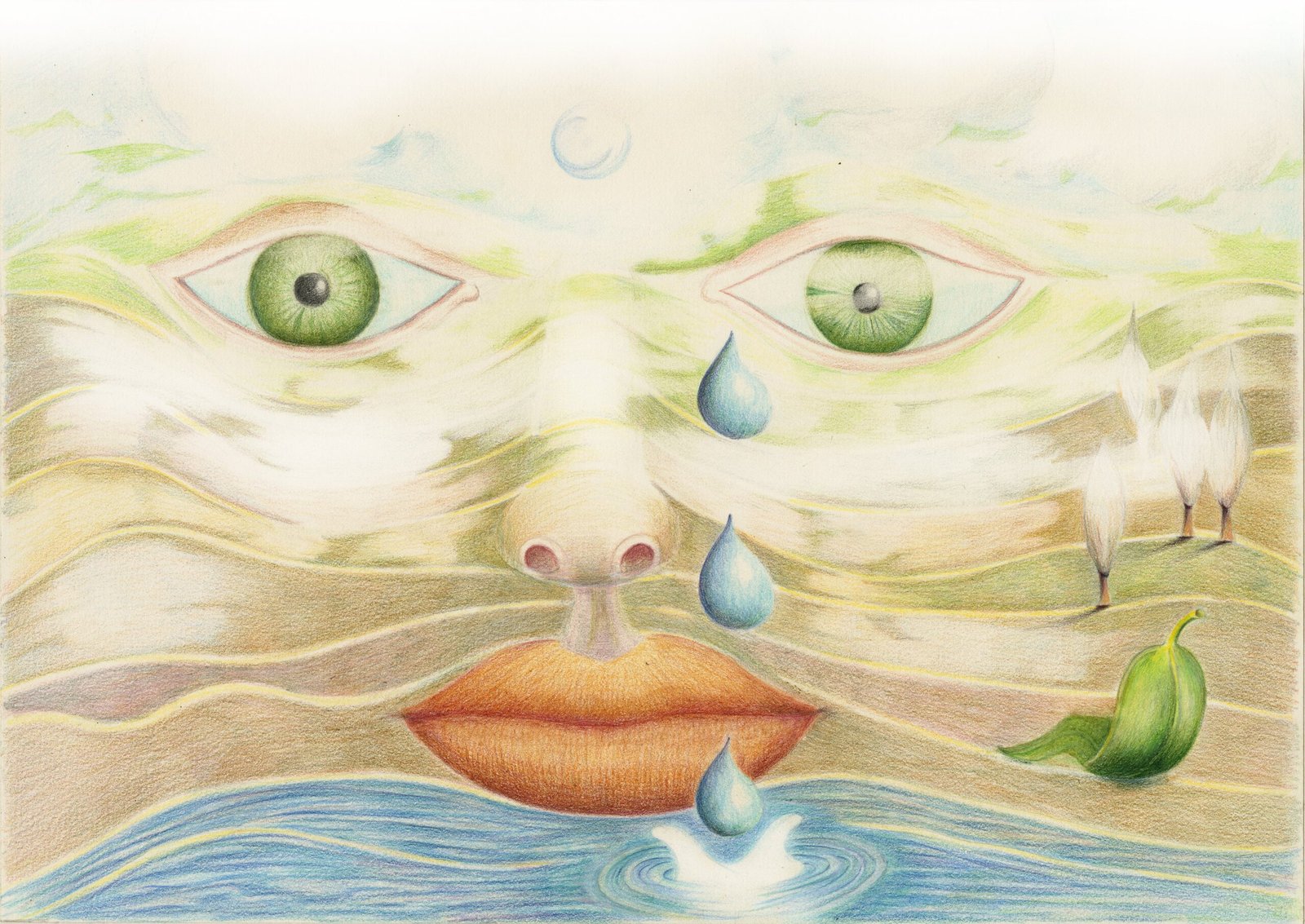
Creating the main character, Flavio, emerged from a drawing rather than a conscious thought, and I guess that’s the magic of illustrating as well as writing. I have often noticed that visual imagination can sometimes, but certainly not always, precede the consciousness of thought. Reflecting upon this, I often wonder whether this is what has contributed to the dreamlike quality of Worlds Within Worlds. The reverse is also true though. Having a thought or a memory, and then crystallising this within an image, like for example Mother Earth weeping, is also a delight. Bringing an internal impression, feeling or thoughtform into an external vision is probably one of the most enchanting experiences for me as an artist.
How Flavio came to life
You might notice, as you turn the pages of this book, that while there is an overall feeling and tone that unifies the illustrations, the drawings are quite diverse in style. This is in a large part because the writing and illustration of the poem has been self-directed and emergent. Rather than having planned the book as a story board before starting to write and draw, this tale of love and loss unfolded from my own emerging revelations about what had happened to Warren, what had happened to me and what had happened between us. What was happening to me, was the unravelling of my core sense of being within the context of a complex grief as a mystery unfolding before my very eyes, for me to watch and dream into.
The poetry of coloured pencil
One of the unifying aspects of the drawings is the consistency of medium. Every drawing is done in coloured pencil, a technique that I learnt in my late teens, when I started drawing symbolic representations of dreamlike visions, a theme that I have been continually pursuing in my artwork till this day. Pencil is one of my favourite mediums because it is so meditative and immersive. It allows me to home in on an idea, get really up close and intimate with it, as the pencils glide over the page gently to reveal colour, tone, light, shade and depth. But there are many ways to draw and shade with coloured pencil, and throughout the book the style varies depending on the image and the feeling that is evoked through the image. Sometimes the colour is built up from many densely applied layers, but at other times, I have used the pencil more sparingly, so that the space between lines of colour is how the form presents itself.
The balance of visual imagery with poetry
While not often illustrated, the illustrating of poetry adds a richness to the feeling states that are evoked, both for the reader and the artist. I often think that paintings and drawings in themselves are the poetry, and so it’s important when combining poetry with visual imagery that one doesn’t take over the other. I hope that in Worlds within Worlds, I have brought these two artforms together in a way that complements rather than overwhelms, so that the riches of both image and poetry integrate alchemically to create prayer.
You can explore the book and original prints in the shop.